22nd Nov, 2025
"Brother, this generator no fit carry my pumping machine o!"
If you've ever heard this complaint (or made it yourself), you're not alone. Thousands of Nigerians buy generators every year only to discover they can't power all the appliances they need. The frustration of buying a ₦350,000+ generator only to find out it trips when you turn on your air conditioner is real.
The problem? Most people don't know how to calculate the right generator capacity (kVA) for their homes. They either buy generators that are too small (wasting money when they need to upgrade) or too large (burning more fuel than necessary).
Today, we're solving this problem once and for all. This complete guide will teach you exactly how to calculate the right generator size for your 3-bedroom flat, with clear examples of what a 3.5kVA versus an 8kVA generator can actually carry.
Before we dive into calculations, let's quickly clarify what kVA means because many Nigerians use the term without really understanding it.
kVA = Kilovolt-Ampere
It's a measure of the generator's power output capacity. Think of it like the size of a water tank: a 3.5kVA generator is like a small water tank that can supply a certain amount of water (power), while an 8kVA generator is like a much larger tank.
Important distinction:
So a 3.5kVA generator actually provides about 2.8kW of usable power, while an 8kVA generator provides about 6.4kW.
Don't worry if this sounds technical—we'll make it simple with real-world examples.
Buying the wrong generator size costs you money in three ways:
The sweet spot? A generator that runs at 60-75% of its maximum capacity for your typical daily usage.
To calculate the right generator size, you first need to know how much power each appliance consumes. Here's a comprehensive list of common Nigerian household appliances and their typical power consumption:
| Appliance | Power Consumption |
|---|---|
| LED Bulb | 10-20 Watts |
| Energy Saver Bulb (CFL) | 20-40 Watts |
| Incandescent Bulb | 60-100 Watts |
| Phone Charger | 5-10 Watts |
| Laptop + Charger | 50-100 Watts |
| Desktop Computer + Monitor | 200-400 Watts |
| WiFi Router | 10-20 Watts |
| DSTV/GOtv Decoder | 15-30 Watts |
| Appliance | Power Consumption |
|---|---|
| 32-inch LED TV | 50-80 Watts |
| 43-inch LED TV | 80-120 Watts |
| 55-inch LED TV | 120-180 Watts |
| Home Theater System | 100-300 Watts |
| Standing Fan | 60-100 Watts |
| Table Fan | 40-80 Watts |
| Ceiling Fan | 70-120 Watts |
| Appliance | Power Consumption |
|---|---|
| Small Refrigerator | 150-250 Watts |
| Medium Refrigerator | 250-400 Watts |
| Large Refrigerator | 400-800 Watts |
| Deep Freezer (Medium) | 300-500 Watts |
| Microwave Oven | 1,000-1,400 Watts |
| Blender | 300-500 Watts |
| Electric Kettle | 1,500-2,000 Watts |
| Toaster | 800-1,500 Watts |
| Electric Cooker (Single Plate) | 1,000-1,500 Watts |
| Electric Cooker (Double Plate) | 2,000-3,000 Watts |
| Appliance | Power Consumption |
|---|---|
| Pressing Iron (Dry) | 1,000-1,200 Watts |
| Pressing Iron (Steam) | 1,800-2,000 Watts |
| Washing Machine | 500-1,500 Watts |
| Water Pumping Machine (0.5HP) | 370-500 Watts |
| Water Pumping Machine (0.75HP/1HP) | 560-750 Watts |
| Water Pumping Machine (1.5HP) | 1,100-1,500 Watts |
| Air Conditioner (0.75HP - 1HP) | 900-1,200 Watts |
| Air Conditioner (1.5HP) | 1,400-1,800 Watts |
| Air Conditioner (2HP) | 2,000-2,500 Watts |
Important Note About Starting Power (Surge Power):
Some appliances need 2-3 times their normal running power when they start up. This is called "starting power" or "surge power." These include:
This is crucial for calculations! Your generator needs to handle these surge demands.
Here's the easy way to calculate what size generator you need:
1. List all appliances you want to run simultaneously
2. Add up their wattages
3. Identify appliances with surge power and multiply by 2.5
4. Add 20% safety margin
5. Convert to kVA (divide by 0.8)
Scenario: You want to run these appliances simultaneously during evening hours when NEPA takes light:
Living Room:
Bedrooms:
Kitchen:
Bathrooms/Compound:
Total Running Power: 100 + 20 + 200 + 210 + 75 + 210 + 120 + 10 + 75 + 300 + 600 = 1,920 Watts
Peak Surge Power (when fridge or pump starts):
Add 20% safety margin: 2,820 × 1.2 = 3,384 Watts
Convert to kVA: 3,384 ÷ 0.8 = 4.23 kVA
Recommended Generator Size: 5kVA (to be safe and account for future additions)
But wait! What if you only need to run basic appliances most of the time? Let's calculate that too:
Basic Evening Load (No Pumping Machine, No Fridge Surge):
Recommended Generator Size for Basic Use: 3.5kVA is sufficient!
Now that we understand the math, let's answer the most common question: "What can I run with my 3.5kVA generator?"
✅ YES - These Will Work Fine:
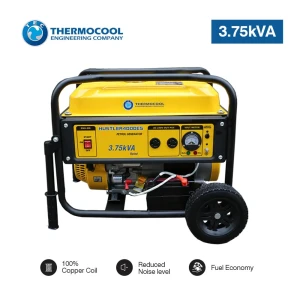
Scenario 1: Basic Comfort
Scenario 2: Basic Comfort + Occasional Heavy Use
Scenario 3: Evening Entertainment
Scenario 4: Quick Cooking
❌ 1HP Air Conditioner (1,200W) + All Basic Appliances
❌ Water Pumping Machine (1.5HP) + Refrigerator
❌ Multiple Heavy Appliances
❌ 1.5HP Pumping Machine Alone
To use your 3.5kVA generator efficiently with a pumping machine:
Now let's talk about the 8kVA generator (6,400W usable power) - the powerhouse that many Nigerians consider "too much" for a 3-bedroom flat.
✅ Everything in a 3-Bedroom Flat - ALL AT ONCE!
Full Load Scenario:
Wait, that's over 6,400W!
The key: You won't run ALL of these simultaneously. Realistically:
Typical Peak Load with 8kVA:
With 8kVA, you can:
You NEED an 8kVA if:
You DON'T NEED 8kVA if:
Many Nigerians overlook the middle options, but they're often the sweet spot for 3-bedroom flats:
Perfect for:
Can carry:
Perfect for:
Can carry:
Let me make this super practical with real scenarios:
✅ Your compound pumping machine is managed by landlord/separately powered ✅ You don't have air conditioning or rarely use it ✅ You're in a self-contain, 1-bedroom, or small 2-bedroom flat ✅ Your monthly income is below ₦150,000 (fuel costs matter a lot) ✅ You primarily need power for lights, fans, TV, and small appliances ✅ Your freezer/refrigerator is small to medium size
Estimated Fuel Cost (8 hours daily): ₦180,000 - ₦220,000 monthly
✅ You have a 3-bedroom flat with moderate appliances ✅ You have 1 air conditioner (1HP) you use occasionally ✅ Your pumping machine is 0.75HP - 1HP ✅ You want flexibility without excessive fuel costs ✅ You occasionally use heavy appliances simultaneously ✅ You're future-proofing (might buy AC or bigger fridge later)
Estimated Fuel Cost (8 hours daily): ₦240,000 - ₦290,000 monthly
✅ You have multiple air conditioners (2+) ✅ Your pumping machine is 1.5HP or 2HP ✅ You run a small business from home ✅ Your family uses many appliances simultaneously ✅ You have both large freezer AND large refrigerator ✅ Monthly income above ₦300,000 (fuel costs less of a concern) ✅ You value convenience over fuel economy
Estimated Fuel Cost (8 hours daily): ₦320,000 - ₦420,000 monthly
Since this is the #1 question Nigerians ask, let's address it directly:
Answer: It depends on the HP rating!
| Pump Size | Running Power | Starting Surge | Works with 3.5kVA? |
|---|---|---|---|
| 0.5HP | 370-500W | 1,000-1,250W | ✅ YES - Very comfortable |
| 0.75HP | 560-750W | 1,400-1,875W | ✅ YES - Works well |
| 1HP | 750-900W | 1,875-2,250W | ⚠️ MAYBE - Tight, avoid other heavy loads |
| 1.5HP | 1,100-1,500W | 2,750-3,750W | ❌ NO - Exceeds surge capacity |
| 2HP | 1,500-2,000W | 3,750-5,000W | ❌ NO - Way beyond capacity |
Pro Tips for Running Pumping Machines on Generators:
Most pumping machines in Nigerian 3-bedroom flats are 0.5HP to 0.75HP, which work perfectly fine with 3.5kVA generators. The issues usually come from trying to run them alongside heavy appliances.
Ready to calculate for your own home? Follow these steps:
Step 1: List Your Appliances Walk through your home and write down:
Step 2: Find the Wattage Check the labels on your appliances (usually on the back or bottom). Look for:
Step 3: Identify Surge Appliances Mark appliances with motors (fridge, AC, pump, washing machine, fans) - these need surge power.
Step 4: Calculate Your Peak Load
Step 5: Add Safety Margin and Convert
Mistake #1: "My neighbor has 3.5kVA, so I'll buy the same" Your neighbor might not use AC, or might have a smaller fridge, or might not care that his generator trips occasionally. Calculate for YOUR needs.
Mistake #2: "I'll just buy the biggest generator to be safe" A 10kVA generator burning fuel at ₦500,000 monthly when you only need 3.5kVA is wasteful. Bigger isn't always better.
Mistake #3: Ignoring surge power Many people calculate total wattage correctly but forget that motors need 2-3x power to start. This is why their "properly sized" generator still trips.
Mistake #4: Not planning for the future If you're planning to buy an AC next year, buy a slightly bigger generator now. Upgrading costs more than buying right the first time.
Mistake #5: Buying based on price alone A ₦250,000 generator that can't power your needs is more expensive than a ₦450,000 one that does everything perfectly.
Many people worry: "Will a bigger generator burn much more fuel?"
Here's the truth with real numbers:
| Generator Size | Fuel Consumption (per hour) | 8 Hours Daily | Monthly Fuel Cost (₦930/L) |
|---|---|---|---|
| 2.5kVA | 1.0L/hour | 8L/day | ₦223,200 |
| 3.5kVA | 1.5L/hour | 12L/day | ₦334,800 |
| 5kVA | 2.0L/hour | 16L/day | ₦446,400 |
| 6.5kVA | 2.5L/hour | 20L/day | ₦558,000 |
| 8kVA | 3.0L/hour | 24L/day | ₦669,600 |
The difference between 3.5kVA and 5kVA: ₦111,600 monthly The difference between 3.5kVA and 8kVA: ₦334,800 monthly
That ₦111,600 monthly difference might seem like a lot, but ask yourself:
For many households, the ₦100,000-150,000 extra monthly fuel cost for a properly-sized generator is worth the convenience and peace of mind.
For a typical 3-bedroom flat in Nigeria (family of 4-6 people, moderate appliances):
Best Value: 5kVA Generator (₦350,000 - ₦800,000)
Budget Option: 3.5kVA Generator (₦350,000 - ₦500,000)
Premium Option: 6.5kVA - 8kVA Generator (₦500,000 - ₦800,000)
Ready to purchase your generator? Here's what to look for:
Buy from authorized dealers for:
Top Generator Brands in Nigeria:
Looking for quality generators with expert advice? Visit GDE.ng where we offer:
Our generator experts can help you choose the perfect size for your specific needs. No more guessing, no more mistakes - just the right generator for your home.
Buying the right generator size isn't just about the upfront cost - it's about years of convenience, fuel savings, and peace of mind. A properly-sized generator means:
For most 3-bedroom flats in Nigeria, a 5kVA generator hits the sweet spot - powerful enough for everything you need, but not so large that you're wasting fuel money every month.
Still not sure which size is right for you? Drop a comment below with your appliance list, and we'll help you calculate the exact capacity you need!
Related Articles:
Have questions about choosing the right generator? Our team is ready to help! Visit our showroom or call us for free expert consultation.
Prices and specifications mentioned are based on November 2025 market conditions and may vary by location and brand. Always verify current specifications before purchase.